Remember how your state changes when the people around you keep a shared rhythm with you: walking in step, singing, keeping silent. At such moments the habitual idea of yourself as a separate spectator recedes — and it is easy to take this for a mood rather than a property of the group. The inventory below is about group work in which each participant held their own place in the common construction. Today, in any shared activity — a conversation, a walk, working side by side — notice the moment when your rhythms coincided, and what changed in you at that moment.
Practice Group work on geometry that ran in halls in 2017–2019. Recorded here is what the method was, where and when it worked, and what confirms each session.
The crystal lattice holds every cell in its place with a spread of hundredths of a nanometre — and so throughout the whole volume. The inventory of sessions follows the same rule: the numbers are read from a data file, not written into the markup, and each session is either confirmed by a document or plainly marked as unconfirmed. Precision is when a discrepancy is visible.
The numbers are live: they are read from the register of sessions when the page loads.
How the practice itself works
The mechanics are described in the cards of the 2017–2019 sessions themselves — the same documents from which the register below is assembled. It is a historical source: it shows how the practice was arranged in those years.
A participant is an operator with a number
The group takes its seats by number, not at random. The number is a place in the scheme, and it determines the moment at which a person joins the construction.
The layout and the order of calling
The seating goes “by numbers in the Flower of Life, according to a specific algorithm based on the proportions of the harmonics of the Platonic solids”.
Building the figure
The work is done by constructing the Platonic solids: a flat layout and its raising into volume. This is the same geometric circuit in which the platform’s five solids and the octave live.
The circle is working together and by a scheme. Next to it stands what a person does alone and without a group: the author’s method “Order from Conditions” — four conditions from which order takes shape, and three practices with exact timing: the return for ten seconds, the checkpoint for two and the reset for nine minutes.
- Notice anything. A word on the screen, a sound in the room, your own in-breath — the first thing that comes along.
- Look at what is noticing it. Do not answer in words: the question has been asked, no answer is needed.
- Stay where your attention has landed, for ten seconds.
- Go back to reading. That was Return — the first of the three practices below. The turn is made once: do not look for a second observer.
What the session cards do not contain and why: the numerical series of the practice and the explanatory frame
The numerical series of the practice has not been reconstructed here. How many people make up a full circle, which figure is assembled by what number of operators, and by what rule a number is linked to a vertex of the solid — these quantities are not in the event export. We do not make reconstructions: an empty place is more honest than a filled-in one, and the geometric model of the practice is derived only from the primary source.
📌 The session cards also carry an explanatory frame — about fields, the ether and the nature of consciousness. Its place is the historical document, and it is examined by the scientific circuit; this page holds the inventory of what is confirmed by a document. Where the boundary between them runs — on the “ceiling” screen below.
Three practices — and one step before them
The circle of operators gathers rarely, while the method lives in the days between circles. You do not gather yourself by effort — you remove what was getting in the way of gathering: order is not introduced from outside, it takes shape by itself when the conditions are in place. A person moves one condition directly — attention. Hence the core: three practices, and not a single one more. Before them stands a step that is not done but noticed.
Observation
For one day, do not look for answers but observe — and write down three unusual coincidences or observations that could previously have slipped past your attention. One evening without information noise — and notice how your attention, breathing and your own state change. If not a single observation turned up during the day, write that down too: an empty line is as much an entry as a full one. What matters to us is not “it got better”, but that you noticed it.
Return
You notice anything — and look at what is noticing it. Do not answer in words, stay where your attention has landed, for ten seconds. And notice: what is noticing it does not end at the boundary of the body. What is noticed stays the same, while the place in which it is noticed is larger than it. In an ordinary minute one question is enough: what is noticing it. If it hits hard — the ladder: stop, breathe in, a long out-breath downwards, where it is held in the body, the question — and let go. Do not look for a second observer: the turn is made once.
Checkpoint
Return does not happen by itself — something has to call it up. Three checkpoints a day, and each is tied not to a time but to an event: the threshold of your home, the first sip of water, your hand reaching for the phone. Two seconds to mark the point — then comes Return. A link to an event holds without an alarm clock: people stop noticing a signal by the clock within a few days, while an action you perform anyway stays in place.
Reset
The same movement of attention, lived slowly. Seated, eyes closed, the out-breath longer than the in-breath — nine minutes. If you have a free half hour: the same practice runs for twenty-five to fifty minutes, only the clock changes. In the first minute, put your fingers on your wrist: the pulse follows the breath, and you find the lever with your own hand, not by taking someone’s word for it.
What gets written down is not an impression but an observation. After Return or Reset — three lines, always the same ones:
- ① what you noticed
- ② what changed
- ③ what question remains
In the evening — one line: how many checkpoints happened. Not “did I do them well”, only the count: zero, one, two, three. Zero is an entry too, and it says something about the day, not about you. That is where the whole diary ends.
The form is for printing: the page saves nothing and sends nothing anywhere — a notebook is enough. The full protocol of the four steps, with an analysis of the two ways into Return, is on the page of practices.
In the morning, Return is part of the daily “Morning Vector” ritual — on the first sip of water, as the first checkpoint of the day: a two-part ritual →
The practice and these three lines are the entrance to the inner circuit of the laboratory: it explores what a person notices in themselves. Next to it stands the outer circuit — what is taken by an instrument and checked against data. The circuits are equal, and the question at their junction remains a question: a link between what is lived and what is measured is not assumed in advance. The inner laboratory →
Three short moves on the spot: from a glance, from an argument, from an object on the table. Each is done where you are now and ends with a line in your notebook.
- Stop at any moment of the day for ten seconds.
- All day long attention shines outwards — onto tasks, people, the screen. Ask: what is noticing this sound, these thoughts, this view right now?
- Shift your attention from what you are looking at to where the looking comes from: not to a thought about yourself, but to the bare fact that something is seen.
- A line in the notebook: what was there before the turn and what remained after.
- If you feel like arguing or proving you are right — do not stop the thought with your head.
- Shift your attention into your body and find the point of contraction: chest, throat, jaw.
- Feel the air a metre behind your back and a metre above your head.
- Let the contraction spread out into the volume of the room: the position arose in a space that is larger than it.
- A line in the notebook: where the contraction was and what became of it.
- Look at any object in front of you: a cup, a tree, your own hand.
- For fifteen seconds, mentally erase its name — forget what it is called and what it is for.
- Look at it the way an infant looks — before the mind has had time to hang a label on it.
- A line in the notebook: what object it was and what became visible in it without a name.
The moves are short on purpose: they are done every day. The first go introduces you to the move, while the exploration happens in the repetition — on each new go you notice something of your own in the same seconds, and the notebook keeps what exactly.
Stop for a few minutes
Think over three questions, then write one line for each. An answer has one measure: whether it is honest.
What people say after the circle
The method is Vadim Kovalev’s own scientific system. The principle is open and described above: each participant takes their place as an operator with their own number, the seating follows an algorithm based on the proportions of the harmonics of the Platonic solids, and the figure rises from a flat layout into volume. The algorithm itself — the order of numbers and the rule of calling — is the author’s closed development: the essence is shown, the details are not disclosed.
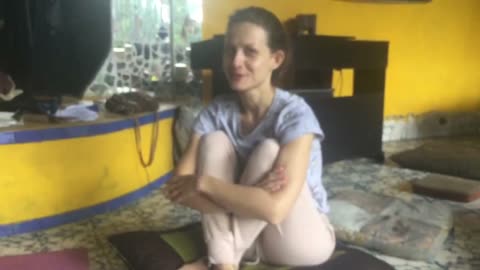
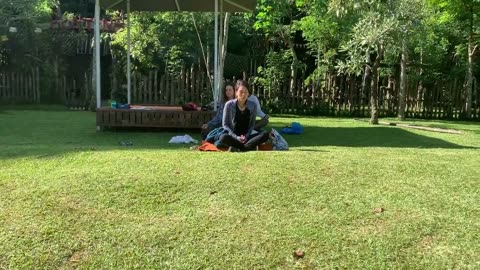
The recordings were made at the end of sessions on Koh Phangan and Bali: people say in their own words what has just happened to them in the circle, without editing. Here are six recordings in Russian, from a brief remark to a conversation of several minutes.
 0:26
 0:34
 0:43
 1:02
 2:12
 4:43
The whole archive of recordings from the circles — short remarks by one person and recordings of a whole circle where everyone speaks in turn — is on the reviews page, in the section on the method’s practice.
The timeline — the method as a whole, not a segment
Two years taken out of the line read like an episode from someone else’s biography: it happened and it ended. That is why the 2017–2019 segment stands here inside the line, not instead of it. Each segment is labelled with what confirms it today.
The empty segment 2019 → 2022 is shown as a dotted line and labelled as a debt on purpose. A hole named out loud costs less than a hole found by an outsider.
The register of sessions
One line — one session. Not a single human name, not a single participant’s quote, not a single percentage. You cannot argue with an advertising block, but you can with an inventory, and that is its point: every line can be disputed by date, place and source.
What limits the segment. The inventory ends where its source ends: the register is assembled from a Facebook event export, and it contains not a single session earlier than October 2017 or later than May 2019. What came before and after is on the timeline above, and each segment is labelled with what confirms it.
Open the whole inventory — all sessions as lines: date, country, venue, format, source and confirmation status
| ID | Date | Country | Venue | Format | Composition | Figures | Source | Confirmation |
|---|---|---|---|---|---|---|---|---|
| Loading the inventory… | ||||||||
🔴 The “Composition” and “Figures” columns are empty in every line — and this is data, not an unfinished job. In the event export, not a single session has these fields. They could have been filled in plausibly, and it would have been untrue; an empty cell shows where the inventory is thin, and it is precisely this column that makes the register a scientific object rather than a showcase.
What follows from this — and what the next step will give
This screen leads up to the invitation and is read in full: here you can see what the inventory already gives and by which step its material becomes a number.
What follows
- The method existed in the field: the dates, venues and format of the sessions are confirmed by documents, not by memory.
- The practice has a continuous segment — from October 2017 to May 2019, dozens of sessions in a row.
- The archive gives hypotheses and categories: what was observed, what distinctions arose, what is worth measuring next.
- The inventory is verifiable: every line can be checked against its source and disputed.
Next step
- An effect is confirmed by prospective measurement. A retrospective record of sessions gives material for a hypothesis, while the number comes from a cohort following a plan written down in advance.
- Frequencies and percentages are calculated from the prospective cohort — with a control and an outcome named in advance.
- The explanatory frame of the 2017–2019 cards remains a historical document and is examined in the scientific circuit.
- The archive is about group work on geometry; the Mineral is spoken of on its own pages.
Confirmation comes from a prospective cohort following a plan written down in advance: what we measure, by what method, with what control and at what outcome we consider the hypothesis unconfirmed. The archive is the entrance to such work.
The invitation
We invite you into work where the result will become verifiable — with a plan written down before the start, not after.
See how the check works
What is already under protocol and what is not yet — on a separate page, with nothing left unsaid.
Read the open questions
Each one has its path of verification and its condition of non-confirmation written down.
Join the prospective cohort
Taking part in the cohort goes through the Research Centre — the terms are there too.
The practice begins with the carrier — the Mineral holds the routine through its substance, not through a reminder. Choose a level and order →
“You are used to looking for the answer inside your thoughts. But perhaps the time has come to explore awareness itself, thanks to which thoughts become known to you.”
Ты видишь эту строку.
И знаешь, что видишь.
Второе случилось без единого слова.
Вот к нему и стоит вернуться.
Глаз не видит себя. Свет не освещает себя.
И всё же ты знаешь, что ты есть, —
раньше любой мысли о том, кто ты.
Откуда это знание? Не отвечай — посмотри.
Сначала ты замечаешь мысль.
Потом находишь внимание, которым заметил.
Разверни фокус на него самого.
Попробуй найти, где у него стенка.
The inventory above is a document of 2017–2019. The practice that goes on today lives in your account and is opened with carats: they come together with the Mineral, exactly to the amount of the level — the Mineral for 377 € gives 377 carats, and the person chooses for themselves what to open.
- Practice8carats
- Meditation8carats
- Lesson13carats
- Book55carats
The eight octave meditations on the meditations page are open free of charge and without sign-in — the price applies to the recordings in your account.
Each of the sixty-four facets of the Atlas has its own experience — one action that is passed through by doing, not by reading. Eight parts of eight facets, and what you have walked adds up to the reader’s crystal. Walk the Path of the Atlas →
Where this leads
The inventory shows how the group came together. The next step is how you come together
In group work each person held their own place in the common construction. You can ask yourself the same question: are your thoughts, feelings, intentions and body in alignment — and what changes when you notice it. The next step leads there, and the turning of focus onto attention itself, which the words above speak of, is the step after it. How to keep attention gathered on an ordinary day is covered in the course “Gathered Attention”.
And further on is what this page began with, only from the inside. Attention is gathered on one thing, and the focus turns onto attention itself; when this turn too becomes habitual, attention recognises itself as part of the shared unified field of consciousness and looks from there — just as the separate spectator recedes in a shared rhythm. This experience from the inside is described in detail by the direction “The common field of consciousness”.
- 1. recognition
- 2. self-awareness
- 3. coherence
- 4. the nature of consciousness
- 5. unity
The inventory of group work stands on the third step.
You are now in the middle of the line on which the whole platform stands: the Mineral is the material centre of the direction; order that holds itself is self-organization; in a person it reads as coherence, the alignment of body, attention, reactions and behaviour; alignment can be seen in a person’s state, and it is the person who observes it; further on, the question turns towards the study of consciousness. The field archive shows what alignment is actually gathered with — in a group and on an ordinary day. Scientific basis →