◆ Point of Origin
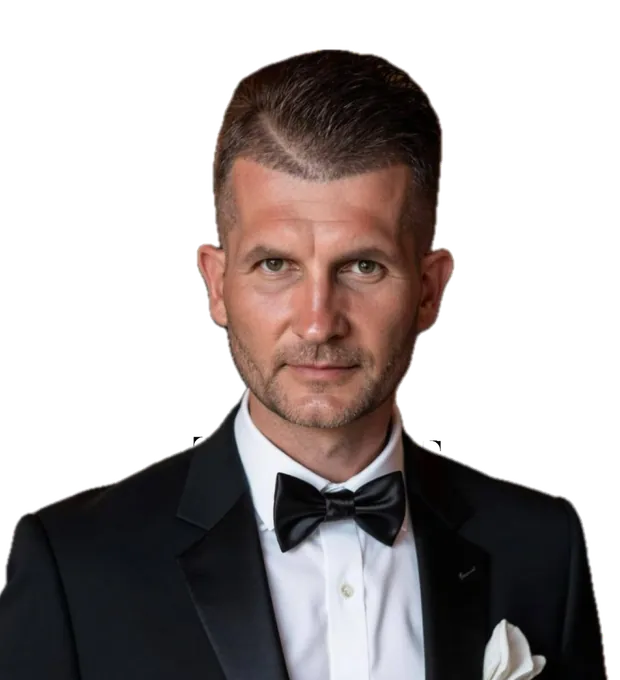
Vadim Kovalev — portrait: a man in a tuxedo, looking into the camera
Vadim Kovalev
About the author · how a researcher was born

Point of origin

You may know the moment when your familiar image of yourself — a position, a role, other people’s expectations — stops matching who you feel you are. This story is about a person who took a step at such a moment, and about the questions that came after; below you can walk it as your own path and see where on it you stand. The first step is the same for everyone: turn the focus of attention onto attention itself — onto that with which you are looking right now.

The point of origin of this story is a single moment in a car.

“It all happened spontaneously. I was sitting in the car and felt cats scratching at my soul, telling me ‘set out on the road’”Vadim Kovalev

In December 2011 he was offered the leadership of a district the size of Denmark — and he left at the peak, and that same month found himself in Thailand for the first time. The dates stand side by side here so that you can check every turn.

In 2011 he was a local celebrity in his city: a lecturer, the head of an organisation, a member of the governor’s team, with a business-class Mercedes. Neither fame nor the car brought him pleasure any more, and all of it had stopped feeling clean to him.

The path from illusions to oneself — the same story as a single narrative →collapse

On the outside everything had come together: recognition, prospects, a circle, a business-class Mercedes. And in that very car came a feeling he calls a calling: something inside would not let him rest.

He left at the peak, and in that same December of 2011 found himself in Thailand for the first time. The years that followed were divided between sports camps and monasteries.

Out of this road — through alchemy and ancient knowledge — Kovalev Mineral grew.

Four moves: what you call yourself and where attention is looking →collapse

You have been told about presence and awareness many times, and each time the explanation turned out longer than the thing itself. Here it is, shorter, in four moves. The first — what you call yourself is a trace: a set of habitual reactions, which is held only by attention; it was assembled for the sake of happiness, and only one who exists can be happy. The second — find where your attention is right now. The third — take attention off the reaction, find your attention and turn the focus onto it — onto the awareness that cannot be doubted: this is the main thing, the single action of the whole path. The fourth — notice: you are no longer looking from the head but from the shared — from the same thing everything around you is made of; this is recognised in experience and cannot be derived from physics, and the boundary thins. It is available to everyone, because it is already yours: what is needed is a habit.

Thus begins a return to your original nature. Why it works: the body is built like a tuned circuit, and when alignment holds in it, the noise subsides. You can come here with tiredness at the end of the day, or for depth; both reasons are honest. As long as there are an observer and the observed, there are still two; the transition lies where no two remain and one is looking. What you receive, by returning attention again and again, is a support that does not need a good day, and with it quiet, evenness and a taste for life. You verify the first three moves by observing yourself; the fourth is recognised in experience. The Mineral has one place in this mechanism, as a condition: what usually gets in the way of returning attention is bodily noise; the mineral removes it, and returning becomes easier — you do the returning yourself. The order is the reverse of the usual: first the state, and affairs and circumstances fall into place after it — you can see this in your own day. Below is the same, step by step, with a support under each step.

This story has one subject, and it is not a biography: a return to your original nature — to attention itself, which remains when the habit of taking yourself to be a role and other people’s words is removed. Nature is not acquired — it is remembered.

It works simply: the body is a tuned circuit; when alignment appears in it, thought and the course of the day move in one rhythm, inner noise subsides, and beneath it you can hear your own. Years went into finding this; using it takes one action and one reminder.

It leads further: first the noise subsides, then the boundary grows thin — one is looking, and ancient treatises have spoken of this stage more directly than we can. There are two floors, both honest: tiredness and chaos in your affairs is the lower one, your own depth is the upper; the lower comes along the way.

The beginning of his path is simple: he followed the path of the heart — of his own hero and talent. That path led him onto the path of the Great Work, and its outcome is the system you see on this platform; you can walk it from whichever door you came in by.

Point Zero is not emptiness but the origin of coordinates: a state of purity and potential from which a new system grows. It is also the title of the author’s book — “Point Zero: The Confession of One Who Returned”.

This is not a biography. It is the story of how a way of thinking changed — told not as a chain of miracles, but as a chain of questions.

“We try to rewrite laws on paper while the chief Lawgiver and the chief Instrument are within ourselves. To change the world, you have to tune the instrument itself.”Vadim Kovalev · “Point Zero”
Who is telling it, and by what rule →collapse

Vadim Kovalev is the author of Kovalev Mineral and of the DSOT research programme. The story below is told in scientific language, and it has a single rule: personal experience becomes the source of the next question.

Vadim Kovalev · researcher · author of DSOT
He invites you to check.The “About the author” text approved by the author

Kovalev Mineral — the subject of his work →


Why this story

The research began with society and ended with the human being — and it has one subject: a return to your original nature.

Nothing is added to it. The work removes the interference, because of which your own cannot be heard — so all you can do is remember your own and gather yourself whole. In the sources this state is called sahaja, “born together”: not earned, not handed out for merit, not bought. Hence the whole biography below reads differently: it is not a chain of miracles but a road to the thought that such a return is possible.

Hence the order of all the work, one for the whole project. The Mineral is the means: it gives the body a condition of alignment and does nothing in a person’s place. Self-organisation — the way a living system assembles itself on its own, without an external controller. Coherence — the degree of alignment of the body’s processes, attention, reactions and behaviour. Next comes the human state, which a person notices in themselves. And then the study of consciousness — the very thing it was all started for. Means, method and goal are not mixed here, and complete synchrony is not the goal: a living system is both aligned and flexible.

It is recognised not by words but by four signs — each of which you check yourself in a minute. One looks through many eyes: the same looking that is in you now looks out from thousands of different eyes. The world answers: it has stopped being scenery and answers your move. Admiration without a task: attention is aimed at nothing and hurries nowhere. Life as a game in which you have a move: luck and a blow switch from drama to play, because there is always a move.

It comes from the bottom up, tier by tier, and none is skipped — this is observation of yourself, and you are the one who conducts it: the body — the out-breath comes by itself; the course of the day — a morning without a run-up; the run of events — coincidences come in rows; the shared field — one thing is looking. This is how alignment grows layer by layer, and each next tier stands on the previous one: you recognise it in yourself sooner than in a description.

Each tier has a name older than us, and these names speak not of how the stone is built but of what it connects. Here they are from the bottom up: six tiers, seven names.

bde stong, lightness-emptiness — the body: the out-breath comes by itself, inside it is light and empty at once, and the emptiness is not frightening. There is no longer any need to hold on — this is the first tier of alignment.

sahaja, born together — the course of thought: attention holds by itself, and this is recognised as the return of your own (this name was given above).

ro snyoms, even taste — the level of feelings: praise and silence no longer tear you in two; different things acquire one taste. Breakdowns remain; the way back to evenness becomes shorter.

ānanda, the bliss of the ground — the cell: evenness no longer has to be extracted from people or from events. This is the third name of the ground itself: it cannot be earned and cannot be lost.

camatkāra, tasting — the life around you: events are recognised before they are explained, and the day acquires flavour. The word came from the analysis of food and theatre — a short “ah!” when a taste is recognised.

zung ’jug, yoked together, and vismaya, wonder — the shared field: you and the world pull one load, like two oxen in one harness, and one is looking. It comes as wonder — you see the familiar as if for the first time; in the “Shiva Sutras” wonder stands as a stage of the path.

Hence two doors, and the lower one is not devalued. The lower door: tiredness, chaos in your affairs, money, the day’s decisions — staying with it is full, honest work. The upper door: the person themselves, when nothing interferes — the world is left with no background; this too you check yourself. The first comes along the way; the second does not come along the way and requires a decision to go, and how deep to go is decided only by the person themselves.

Two pictures from an ordinary day — how it works →collapse

A tap and a filter under the sink. Check it in your own kitchen: the same water from the same tap, passed through a filter, brews tea differently — the same kettle, the same tea leaves: it is not the water that has changed but its composition — and everything that happens in it goes differently; tap water in two houses differs in composition too. The stone stands alongside as a standard of order: at the surface of the carrier, water arranges itself in layers — this is measurable physics, and how far the order extends beyond that, we measure ourselves.

A candle flame. In still air it stands evenly and shines far; in a draught it trembles and gathers soot — the same candle, the same wax. Alignment, if you take the poetry out of the word, is when there are fewer parts that have to be held separately. Complete synchrony is not needed: what moves as one lump stops responding to different things.
The method of this story

Three marks: where it is confirmed, where research is under way, where the question is open →collapse
Five steps on which every chapter is built →collapse
01Observation
02Question
03Hypothesis
04Testing
05New question

Every chapter below is built on this scheme: an event gives rise not to a conclusion you are obliged to accept, but to a question you can check on yourself. This is how research works — and this is how the author asked for his story to be told.


Milestones of the path

Eighteen milestones — the whole story in a single column. The first half: university, law, children’s homes, public chambers, the governor’s team. The second: Thailand, monasteries, the ring, islands — and Kovalev Mineral at the end.

Eighteen milestones: from the TSU library to the mineral →collapse
  • Tomsk State University, Faculty of Law; the library as the main place of his youth
  • 2005, at twenty-three — the youth movement “Uniting Young People with the Idea of an Independent Civil Society”
  • A charitable organisation, sports programmes for children’s homes
  • A social adaptation programme for orphans and an institution of social mentoring in children’s homes
  • A social research laboratory, teaching, a dissertation
  • Postgraduate study at TSU under the supervision of Vladimir Utkin, Honoured Lawyer of Russia
  • A law office; an independent expert in anti-corruption review of legislation
  • The Public Chamber, the personnel reserve, a programme for training managers
  • Primaries for the State Duma, the governor’s team — and leaving at the peak
  • December 2011: the governor’s offer to lead a district the size of Denmark
  • Thailand: a change in the object of research — from society to the human being
  • The years of the “inner laboratory”: environment, regime, concentration practices
  • Sports camps and monasteries: “There was no third”
  • Samui, 2014 — a seven-day silent retreat
  • 2015 — the keys are found; the Alchemy of Sacred Geometry method is born
  • Koh Phangan and Bali: alternating work in two hemispheres of the Earth
  • Bali: research into how environmental conditions affect a person’s state
  • The outcome of the search: Kovalev Mineral and the DSOT programme

The story

Seven chapters — seven questions, and each next one was born from the one before. First the object of research was society, then the human being, then environment and structures. You can read the path in a minute by its headings and questions; any chapter opens in full with a single tap.

◆ your marks are kept in this browser · sign in to your account so the path is not lost when you change device

01Prologue · the library

The question where it all began

“I was always an unusual child” — Nietzsche, a night-time library and a note in a diary →collapse

“I was always an unusual child,” is how he begins the story of himself. From childhood he felt that there was something in the world greater than what the eyes can see; mystery drew him, and he trusted life “as if life were a kind and caring mother, ready to give me everything I needed”. The university he entered was more than two hundred years old: balls and assemblies had once been held in its old halls, and the library was filled with ancient knowledge and seemed to keep the secrets of bygone eras.

He entered Tomsk State University and lived in a hall of residence opposite the old library — an imperial-era building where balls had once been held. There were no gadgets, there was no television, and he spent all his free time there: Nietzsche, philosophers, researchers, books you only come across when you are looking not for a course syllabus but for an answer.

It was there that an eighteen-year-old law student first seriously asked himself what he was living for at all. And he made his first decision: to devote himself not only to personal goals but also to what could be useful to society. At the same time he heard that it was possible to set up a charitable organisation — he wrote the idea down in his diary — and the note gave him no peace until it turned into action.

“How can I be useful to the world, to people? How can I become an instrument of the Great Work?” These were the questions that touched me deeply when I was still young. I searched for my place in this world until I realised that the uniqueness of each of us is what makes the world better. Over the years they turned into my principles of life.
“Once, listening to a professor’s lecture, I wrote a simple phrase in my diary: ‘Set up a charitable organisation’. But at the time I could not even imagine how to make it happen… Some time later, that note in my notebook became a kind of manifesto.”Vadim Kovalev · “The Story of Awakening”

What am I living for — and what can I do for a system larger than myself?

02External systems

Researching society

A record of service and a district the size of Denmark →collapse

The following decade was a study of external systems: the state, law, public institutions. He studied what prevents a system from developing, wrote academic papers on corruption, graduated with honours, headed a social research laboratory, taught, and began a dissertation.

Alongside this his practice grew: charitable projects, sports programmes for children’s homes, the Public Chamber, the personnel reserve, a programme for training managers. By twenty-nine — won primaries as a candidate for the State Duma and work in the governor’s team. By outward standards it was a model trajectory with only one “but”: it explained everything except the most interesting thing.

I did not wait for a position to appear for this. I built a system for it… I wrote about what I did with my own hands, and did what I wrote about.based on autobiographical material gathered with the author · wording ours

What exactly he did

  • 2005, at twenty-three — founded the Tomsk regional youth movement “Uniting Young People with the Idea of an Independent Civil Society”: anti-corruption initiatives.
  • TSU Law Institute, graduated with honours; graduation thesis — “Political Corruption”.
  • Postgraduate study there too, under the supervision of Vladimir Utkin, Honoured Lawyer of Russia; research — countering corruption in educational institutions.
  • Lecturer at the Department of Criminal Law, then a research fellow of the university.
  • His own “Law Office of V. V. Kovalev” — criminal cases and the protection of citizens’ rights.
  • Independent expert in anti-corruption review of legislation at the regional Duma; the Public Anti-Corruption Centre at the university.
  • The Public Chamber of the Tomsk Region — elected twice.
  • 2010 — laureate of the international forum “Foros Siberia”, in the “Heritage of Siberia” category; letters of gratitude from the Governor of the Tomsk Region and the Mayor of Tomsk; more than a dozen academic publications.
  • TSU Faculty of Military Training, lieutenant of the Armed Forces of the Russian Federation; 2015 — Law Institute of Moscow State University, “Teacher of Higher Education (Law)”.

Alongside ran what he is prouder of than his positions: a social adaptation programme for orphans and an institution of social mentoring in children’s homes. And sports clubs — the “Druzhba” boxing club, the Sabre Fencing Federation of the Tomsk Region and the Stanislav Pozdnyakov club (2007), the “White Lotus” Thai boxing club (2012).

Free of charge on principle: sport should not be a privilege of those who have money.

His own conclusion about that decade is not about offices: corruption begins not in offices but in a person’s consciousness — when they betray their essence for the illusion of power and security. It was this conclusion that turned the lawyer towards researching the human being.

December 2011 · the point of maximum

He wins the primaries of the All-Russia People’s Front and becomes a candidate for deputy of the State Duma from the Tomsk region; in the same year he joins the region’s reserve of management personnel. Almost immediately the governor offers him the leadership of a territory — one of the districts of the Tomsk Region. To grasp the scale, a single measure is enough: this district is the size of Denmark. A few thousand people across vast territories. Oil and gas. Timber for export. A team of dozens of young professional managers.

I was going to go there to serve, and I use that word without irony: that is exactly how I regarded it.
This work brought me enormous joy. I stress this because what follows is a story of leaving, and leaving what weighs on you costs nothing. I was leaving what I loved.based on autobiographical material gathered with the author · wording ours

What exactly do external systems fail to explain — and can it be studied with the same tools?

03The first observation

Pattern or coincidence?

What exactly kept repeating →collapse

Back in his student years he began to notice one recurring thing — and this observation became perhaps the most important event of the whole story.

“When my actions were aimed not only at solving personal tasks but also at developing a wider system, new ideas, unexpected acquaintances and opportunities arose around me more often. At first I considered it coincidence. But the longer the observations went on, the stronger the question became: is it chance?”

Fifteen years later the author called this observation not an episode of youth but the foundation of everything he built afterwards — and asked for it to be recorded as the cornerstone of the whole philosophy, science and product.

The author’s path is pure synchronicity, and every pillar of his work is built on it. What looks like a miracle from the outside is, in essence, synchronicity.

How this unfolds into a working framework — in a separate section right below the story: the author’s main law →

Chance — or is there a pattern behind it that can be studied?

Next comes the most personal part: leaving the summit, monasteries, a dream and the mineral. Four more chapters →collapse
04A crisis of explanations

A change in the object of research

What he paid for leaving the summit →collapse
“I remember the day I sat in the leather business-class seats of my ‘Mercedes’, having received the governor’s offer to lead a regional project. I had a career full of recognition and success, brilliant prospects, a lavish and full life. But something inside me would not let me rest… I did not know what it was, but I felt a calling.”Vadim Kovalev · “The Story of Awakening”

The book version of the same scene has a single line: sitting in the car with the engine switched off, he caught himself thinking that this life was not his. Success outside, emptiness inside — and a feeling that would not let go.

At the peak of his career trajectory what happened was not disappointment but a crisis of another kind: external systems stopped explaining what was going on. The deeper he understood how society is built, the clearer it became that all large systems share one and the same indissoluble element.

Studying the organisation of society, I gradually understood: it is impossible to truly understand large systems without understanding the system that lies at their foundation — the human being.

That is why, in this story, leaving for Thailand is not “dropping everything” and not “going off to find himself”. It is a change in the object of research: from society to the human being. Not a geographical expedition, but a research one.

What he paid for it

He sums up the motto of those years briefly: “rejoicing in life, taking risks”. He had to leave everything he was rich in and everything he had striven for: his status as a lecturer and research fellow of the university, his seat in the Public Chamber, his status as an advocate, the leadership of organisations, expert positions, his team and a district the size of Denmark. He left with almost no belongings.

To know himself, he had to come to know the world.

The decision is precisely dated — December 2011, when he first found himself in Thailand. But he himself insists: leaving does not mean cutting off. “I came back to Russia, more than once. Briefly and on business: to close what remained, to fulfil obligations that cannot be dropped in a day, to continue the research.” And the conclusion he puts at the end of this act: “It was not my occupation that changed. It was my place of work.”

How is the system that lies at the foundation of all large systems built — and how can it be studied on oneself?

05The inner laboratory

Oneself as a laboratory

The ring, monasteries and three practices by name →collapse

He did not look for one method that would “change a person”. Instead he put the question differently: how does a system change if the conditions in which it exists are consistently improved? And he made his own life a field of research.

It was not one variable that changed but the whole environment: informational noise reduced to zero, a sleep regime, years of living food, hard physical training, ancient practices of concentration and self-observation, life in the mountains, walking barefoot, water, silence. In this period his sport reached the level of international competition — but the point was not achievement, it was the design of the experiment: not to search for a secret, but to create conditions.

He describes these years in one sentence: “I lived either in sports camps or in monasteries. There was no third.” In the camps he came to know himself through the art of Muay Thai — training, professional fights, competing as part of the national team. And he explains why he needed the ring differently from the usual explanation.

I did not choose the ring out of a love of martial arts. It turned out to be the only place I knew where a person’s inner state is tested instantly and with no right to self-deception. In meditation you can consider yourself calm for years. In sparring this becomes clear in ten seconds.based on autobiographical material gathered with the author · wording ours

The other half of those years was spent in monasteries. His teachers were Buddhist, Shaolin and Tibetan monks and masters of other faiths; he practised concentration, relaxation and what each tradition calls by its own name but does in roughly the same way — giving a person back the ability to be where they are. He puts it directly: to take apart this whole volume of fears and illusions within yourself, physical training alone is not enough — you have to go into deep spirituality.

Three practices he names one by one

  • Counting breaths 1→10→1, for an hour on end. Lose count — you start again.
  • A glass of water, carried along a jungle path so as not to spill a single drop. The question behind the exercise: if you cannot keep a glass of water steady in your hand, how will you keep the balance in your life?
  • Observing thoughts — up to the moment when it becomes clear: I am not my thoughts but the space in which they arise.

Those years also included a period of having no money at all and going hungry — right down to pindapata, the monk’s alms bowl. He calls this period an initiation by trust, and he took from it a formula he uses to this day: everything happens not to me, but for me.

What happens to a complex system if its environment is systematically improved?

06The turn

A dream that became a question

Samui, the seventh day of silence — and the keys of 2015 →collapse

After several years of such a life, during a long retreat in a mountain monastery — without communication, without conversation, with a strict regime and concentration practices — he had an extraordinarily vivid dream: geometric structures whose names he did not know at the time and which he had never specifically studied. The dream stayed with him so clearly that he could not regard it as an ordinary dream.

This episode has an exact address: 2014, the island of Samui, a seven-day silent retreat — after three years of daily practice. “In the dream I saw a model — geometry, molecules and arithmetic keys that I did not understand then. In the dream it was also said that they would serve as a breakthrough for all of humanity.” The next morning — “my world became different”.

He does not undertake to explain it and speaks about it carefully, as a supposition: the inner strength accumulated over years of intensive practice rose and switched on the simultaneous work of the two hemispheres — and with them he saw, above all, thousands of false ideas and notions, mainly about himself. His first wish was to get rid of them — to make room.

What surprised him was not the dream itself but its consequences. In the following months he noticed lasting changes: it became easier to hold attention, to notice recurring patterns, to see connections between phenomena, to formulate hypotheses faster. He did not try to explain where this experience came from — instead he asked a question: do objective patterns exist that could have been the source of these images?

The search for an answer led him to geometry, crystallography, the golden ratio and recurring structures in nature — there he recognised forms that seemed to him to be those very images from the dream: the regular polyhedra known since the time of Plato. Whether this is a coincidence or memory fitted the image to the discovery is a question he left open.

The keys · 2015

After this, answers began to come — and he describes it not as learning something new but as remembering something already familiar: everything in nature is subject to certain harmonious laws. An interest appeared in numbers, in the harmonics of notes, in geometric figures, in the structure of electromagnetic fields, in molecular lattices, in scientific theories of how the macrocosm and the microcosm are arranged.

Both thoughts of this chapter — Vadim Kovalev →collapse
I suppose that the inner strength accumulated over years of intensive practice rose and switched on the simultaneous work of the two hemispheres of the brain — and with them I saw, first of all, thousands of false ideas and notions, mainly about myself.Vadim Kovalev · stage 1
“Answers to my questions began to come; I began to remember that everything in nature is subject to certain harmonious laws.”Vadim Kovalev · stage 1

Here exactly what had seemed left behind for ever came in useful: “my former university skill — the ability to build research on scientific discoveries and experimental data — turned out to be exactly the instrument I was missing”. This is the seam between the two halves of the story: the lawyer-researcher did not disappear, he changed his subject.

The structure of the universe is described by calculations… and these calculations and numbers are expressed by geometry. In 2015 the keys to the cipher of the universe were found. This is how a method for the development of consciousness appeared — Alchemy of Sacred Geometry.

Do these patterns exist outside my own experience — and how can this be checked?

07Environment · the mineral

From environmental conditions to the mineral

What the mineral became on his path →collapse

Further travels brought him to Bali, where he met researchers studying how physical conditions affect a person’s state. One of the engineers was building an experimental installation that creates complex electromagnetic fields; participants in such sessions often described similar subjective changes — clarity of thinking, composure, a sense of inner alignment. The participants’ observations raised the next question: can a change in the physical conditions of the environment affect the state of a complex biological system?

Years of experiments with water, crystalline structures and environmental conditions eventually came together as Kovalev Mineral. In the logic of this story the mineral is not a “remedy” and not a separate invention, but one of the results of a many-year search for the conditions in which a person unfolds their potential. The influence of the mineral and of fields on a person’s state is studied by the DSOT research programme — there these questions are formulated and tested openly.

What conditions allow the human system to unfold its potential?

You do not need to go through these years. The camps, the monasteries and the silence went into finding the road; the road, once found, is walked without them — it is available to everyone, without preparation, in your ordinary day. The method has one main action: find your attention and turn the focus onto it. It takes one minute, several times a day, and you can pause on it in the middle of anything you are doing; you can tell by the gap that has appeared between an event and your response. All four steps — with the action, the time and the sign for each — on the “One Road” page.

This is where the system began

The story ended not with a conclusion but with a subject: Kovalev Mineral. What follows is no longer a tale about searching for conditions but the result of that search itself — a grown crystal.

If you are choosing where to begin, the simplest is the first level — Level 1, the most accessible entry. There are eight levels in all, priced in ascending order; M1 opens the product’s starting content.

Choose a level and order → eight levels · from €233 to €6,765

The author’s main law · synchronicity

The cornerstone

Synchronicity is the main law of the whole system: of the science, the product and the path. Why everything goes now with you, now against you →

How the author arrived at this law →collapse

Harmony is synchronicity. When the body works in alignment and an intention at once finds a response, a person is no longer afraid.

From here this thread runs through everything: the quest below, the author’s practice and the mirror of the “Digital Twin” are built on one transition — from chaos into synchronicity. The author asked that a person should feel it through their own experience, rather than read it in an explanation.

The research, the system and the mineral itself were created not for the sake of mechanically “putting things in order”, but for the sake of this transition.


Quest · “Point of Origin”

Walk the author’s path as your own — and see where you stand now.

The rules of the quest and what it shows →collapse

You have just read the seven chapters above with your eyes. The quest unfolds them into a mirror: at each station you first answer for yourself — and only then see how the author acted at this point. No answer is ever judged right or wrong: a divergence from the author is not a mistake but something you learn about yourself.

  • The biography can be read in full without the quest — the content is not locked.
  • There are no points and no ranking: progress is the five steps of the research method.
  • The node at the end is not a label and not an assessment of the person, but a place on the map.
  • The quest gives one thing — a mirror of your train of thought: in the node it leads you to, you will see how you yourself think. The mineral lives separately: the quest is about thinking, the mineral is about the substance.

Seven stations, about ten minutes. A choice cannot be replayed once it is revealed — otherwise the mirror loses its honesty — but the whole path can be rebuilt from scratch.


Quest branch · “Become an Operator”

You have probably heard scattered clapping in a hall suddenly come together into a common rhythm. The author’s monograph “The Geometry of Phase Transitions” is about how a complex system passes from disorder into time, and at what moment a push from outside is needed for it.

The branch takes you through six stations of the book: from a form that has reached its limit to a sphere where all the nodes oscillate as one. At each station — the words of the monograph, three questions on them and an experiment you can set up at home.

The rules of the branch →collapse
  • The stations go strictly in order: the next one opens for you when the previous one is passed. Trying to enter early takes nothing away — the station simply stays closed.
  • The threshold of a station is two correct answers out of three. If you did not reach it, reread the words of the book and pass the station again.
  • The r scale shows how much of the branch has been passed. It is not an assessment of the person and not a measurement: in the book, r measures the alignment of the model’s nodes, not of people.
  • For each station — a trophy: one of the book’s five axioms or a principle of the MUNS protocol. Collect all five axioms — and you receive the “Operator” seal.
  • The monograph is open in full without the branch — read it on the shelf →

The map of the path and the author’s practice

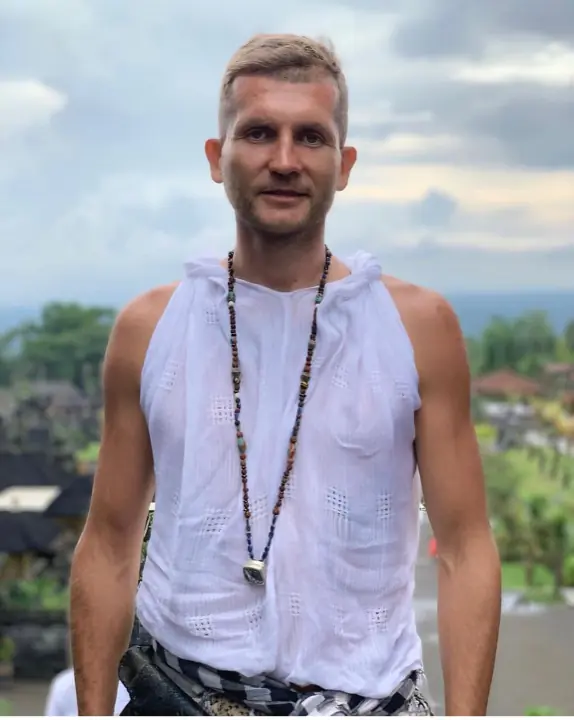
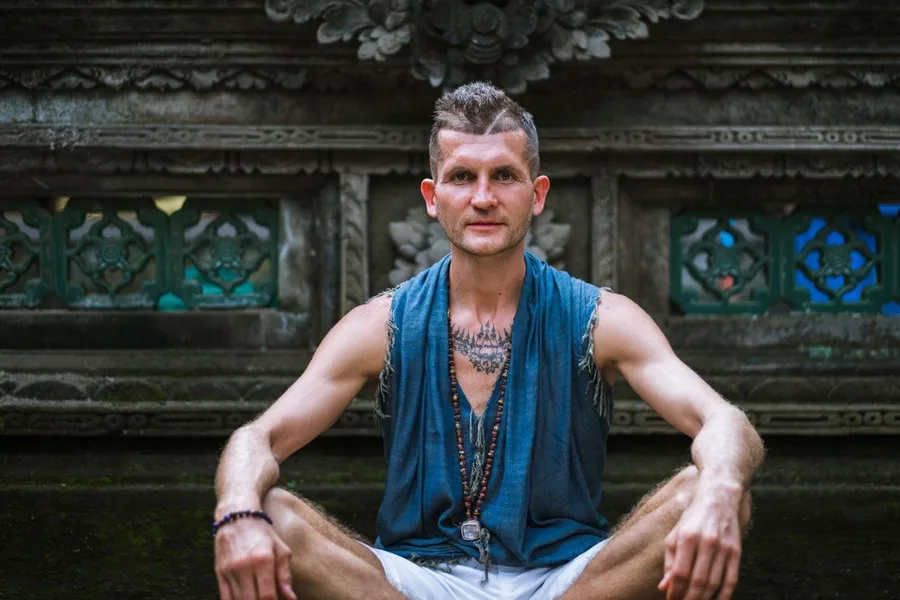
Vadim Kovalev in the lotus position by a carved Balinese altar
Practice · Bali

The quest above leads to one of ten nodes. The map itself is the author’s, from chapter 10 of the book “Point Zero”: living points where people most often stop. It is not a label and not an assessment of the person — the node shows only where the work is going on now.

The map of nodes, the four pillars and the author’s protocols →collapse
  • Isolation
  • Disorientation
  • Emotional storm
  • Crisis of the body
  • Fear of the abyss
  • Mental dead end
  • Rift between worlds
  • The impostor’s shadow
  • Info-chaos
  • Material squeeze

The four pillars of the practicum — chapter 12

  • Islands of silenceOne daily window that nobody has access to. Do not fill it with a podcast or music.
  • Unloading the vesselRegularly freeing the system of the superfluous — in food, things, obligations.
  • A step towards the true callingOne real physical step towards what resonates with you — today, and not “when things become clear”.
  • Absolute trustOne step taken without knowing how it will turn out — and in the evening an honest note of how it all ended.
The author’s protocol · morning attunement, 15 minutes
How the day begins before any screen
  1. 300–400 ml of warm water.
  2. Muscular grounding — the body before the feed.
  3. Do not switch on a screen.
  4. 2–3 minutes of silence, observing thoughts as background noise.
  5. One key priority of the day — write it down on paper. Not a list, exactly one.

Appendix to the book “Point Zero”, block 1. This is a protocol: five steps, each of which you test on yourself in one morning.

Seven days · a mind detox
One condition at a time — as in the whole story above
  1. Days 1–2 · Silence of notifications. Switch off all push notifications, leave only direct calls.
  2. Days 3–4 · The evening digital curtain. An hour and a half before sleep — no work at screens and no social media; note what time you went to bed and what time you fell asleep.
  3. Days 5–6 · Switching off external noise. Move around, walk and train without headphones, radio and podcasts.
  4. Day 7 · “Point Zero” mode. Six hours of informational vacuum: without gadgets, books and conversations.

Appendix, block 2.

Express practice · “Return to Point Zero”
Thirty seconds when it overwhelms you
  1. A physical stop for ten seconds.
  2. Sensory anchoring 3-2-1: three objects with your eyes, two sounds, one bodily sensation.
  3. The formula of disidentification: “I am not this situation and not this emotion. I am the space in which all of this is happening.”

Appendix, block 3.

My path is an example of how material success can become the beginning of a deep awakening, if you are ready to let go of the old and open your heart to the new. Life is not a race for achievements but an astonishing journey to oneself.Vadim Kovalev · epilogue of “The Story of Awakening”

The author tells the same story in his own voice — the talk “How to Begin Your Spiritual Journey. My Story of Spiritual Awakening” is in the platform’s video hall, act I “The Threshold”.


Now — about you

The same question that led the author through the whole story you can ask yourself: where the connections of your life hold, and where they sag.

The “Digital Twin” — eight spheres, twenty-four questions. Not an assessment and not a label, but a mirror. The result opens at once and in full — without registration and without an email address.


Distinctions and path

Before turning to inner research, Vadim Kovalev travelled a notable path in external systems. The sporting part is confirmed by the organisers’ documents — the competitions are named in the block. The sections on education, society and politics are compiled from the author’s personal autobiography and checked against an independent 2011 publication — the regional edition of “Komsomolskaya Pravda”, where his name, date and place of birth, the TSU Law Institute, the 2005 graduation, the law office and the anti-corruption centre are named in the same words: tomsk.kp.ru. Dates and positions are in the dated chronicle below.

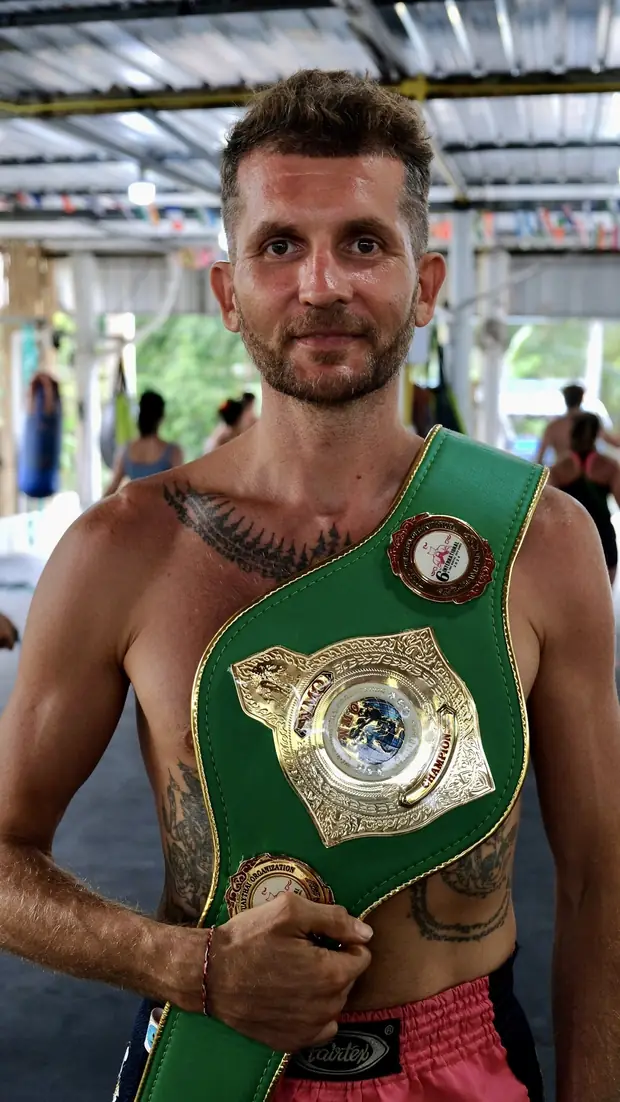
Vadim Kovalev with a championship belt
Four blocks of distinctions — and where the document ends → collapse
01Science and education
  • Tomsk State University, Faculty of Law — diploma with honours
  • Headed a social research laboratory; taught, did research and wrote a dissertation
  • Many courses of study in management; completed the presidential programme for training managers
  • The core of the present scientific corpus is the monograph “The Geometry of Phase Transitions”: the link opens the volume itself in the reader, not the table of contents. The systematics of the DSOT formula, parameters and classes of technology is in the scientific section. A short way in — The Golden Chapter “The Law of Transition”: a compressed nine-minute core from which the monograph grew, open the chapter in full; both texts are on the shelf of works
  • The scientific circuit — two dissertation works: a theoretical one (self-organisation of complex systems, 16 chapters) and an empirical one, in English (physicochemical variability of water–mineral systems, over 300 pages)
  • The monograph “Fractal Matrices of Matter” and a series of research books: “The Harmonics of Creation”, “Water. Frequency. Consciousness”, “The Biophysics of Human Awakening”, “The Biological Code”, “The Universe That Builds Itself”, “Bioresonant Architecture”, “The Crystal” (Liber Crystallis), “The Alchemy of Gaia”
  • All the works are published under the imprint of the Centre for Directed Self-Organization — the author’s own research centre; together they form his current fundamental base
02Society and the state
  • Founded a charitable organisation and led it; oversaw free sport in children’s homes
  • Member of the Council of Public Initiatives and of the Public Chamber
  • Was placed in the national reserve of political personnel
03Politics · by the age of 29
  • Won the primaries as a candidate for the State Duma
  • Joined the governor’s team
  • Received an offer to lead districts and to join the region’s governing body
04Sport and way of life
  • Muay Thai: the Russian national team, international competitions
  • World MuayThai Championship — Ayutthaya, Thailand, 2025 and 2026; 7th International & Thai Martial Arts Games — Bangkok, 2025.
  • Ten-time world championship medallist; a championship belt, medals, professional fights
  • More than ten years of living food; six years of travelling the world barefoot
  • Thai boxing since 2012, and since 2014 — as part of the national team: performing at world championships every year. More than ten years in a row — stepping out every year and proving it not with words
  • President of the Thai Boxing Federation of the Tomsk Region — since 2012
  • Still steps into the ring: training for the next season
  • Lives in different parts of the planet, choosing places at the nodes of the Earth’s crystal lattice; for many years his home has been a mountain in the tropics: no electricity, no running water and no connection, water from a waterfall on his land, evening light from a kerosene lamp and candles, going online in a short evening window

He does not call it asceticism himself: “It is more of a long experiment conducted on myself: you change one condition and watch what happens — not for a month, but for years.” And he asked to be presented not as a list of merits but as a single line — as a polymath in the original sense of the word: a person who develops all facets at once — mind, spirit and body, sacrificing none for the sake of another. The ring, the monastery and the laboratory turned out to be one undertaking. Everywhere the same thing is tested: what remains of a person when everything superfluous is taken away.

Where the measured ends and the author’s path begins

  • The author’s distinctions stand as a single formula — ten-time world championship medallist; in the block of distinctions — his photo with the championship belt.
  • His own works speak on the platform in his voice — books, manuscripts and texts he wrote for the reader. Other people’s words appear with their names.
  • The biography tells where the question came from; about the substance itself you will learn on the technology and science pages — each about its own subject.
  • In the scientific section, next to each statement stands what it rests on: a measurement, a calculation or an open question.

Vadim Kovalev · in the community — Hermes, Mercurius ter Maximus


The call of the name

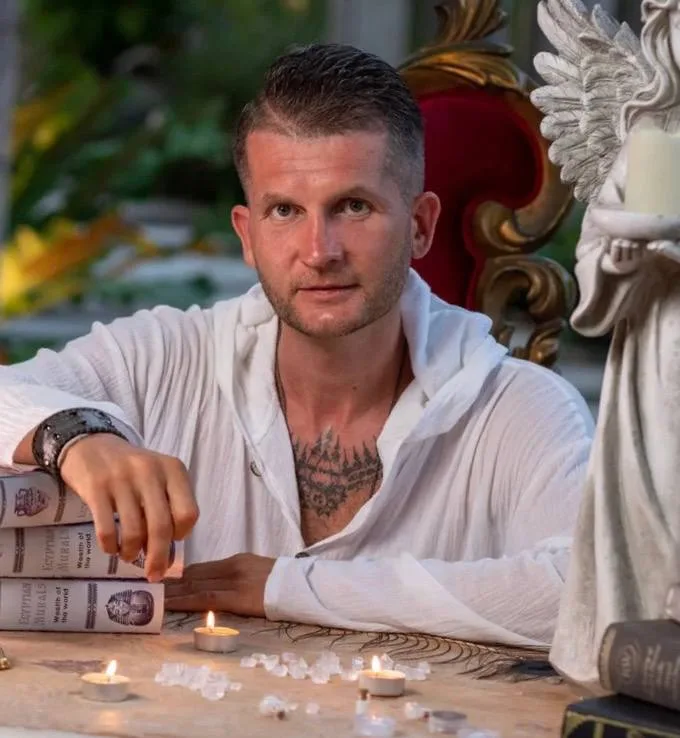
Vadim Kovalev at a table with books, candles and crystals
The call of the name
The line above is not a title but a renunciation of titles

During his awakening he read avidly books about the way of the warrior and seized on one idea: to erase personal history.

How the name came and what follows from it →collapse

He sat down in deep meditation and saw how many former merits, distinctions and statuses his own “I” had fed on — the university, the chamber, the bar, the primaries, the district. To dissolve this and become an empty vessel, he decided to give up his former name. And he asked a question into the silence: what is my true name? how do I sound?

The answer came in a soft, familiar voice — as if a mother’s: “Hera… Hera… Hermes…”. The next morning he opened the sources and read with astonishment who Hermes Trismegistus was: the legendary founder of alchemy, who gave the world the One Law — “as below, so above”, a synthesis of nature, science and observation of the sky. At that time he did not yet know that the road would lead him to work with the structure of matter.

The point of the episode is not the name but the direction of movement: the name came not as a crown but as a sign — and exactly at the moment when the man agreed to become nobody. We mention it once and do not make a title of it.

The wisdom he took from this period

“I really was not able to control this process — rather, it controlled me. I follow the call of the heart and my inner voice, allowing the process to pass through me.”Vadim Kovalev · “The Story of Awakening”

It reads like this: the process went by itself, and his share was to follow the call of the heart and the inner voice without hindering the process from passing through him.

He himself formulates it as a rule: it is not you who guide the process, but the Process that guides you. A discovery, in this framework, cannot be appropriated by the ego — it only passes through a person.


Dossier · a dated chronicle and the public path

The “Distinctions” section above is a summary. Here the same is unfolded year by year, as the author wrote it down himself. The two addresses at which the project exists not only in a browser are right below, in the block “The project’s philosophy and material base”.

A chronicle by year and public activity →collapse

01 · Chronicle of the outer path — from the author’s personal autobiography

  • 2005Graduated from Tomsk State University, law. Entered postgraduate study at TSU. Headed the Tomsk regional youth movement.
  • 2006Lecturer at Tomsk State University.
  • 2007Junior research fellow at TSU. His own law office. Member of the Council of Public Initiatives of the State Duma of the Tomsk Region. Entered the Presidential Programme for Training Managers. Headed the research and expert department for the prevention of corruption at the laboratory of socio-legal research of the TSU Law Institute.
  • 2008Member of the Public Chamber of the City of Tomsk. Head of the Tomsk regional branch of the all-Russian organisation “Centre for Countering Corruption in State Authorities”.
  • 2009Member of the Public Chamber of the Tomsk Region.
  • 2011Included in the reserve of management personnel of Russia. Stood as a candidate for deputy of the State Duma for the Tomsk Region — list of candidates, tomsk.kp.ru.
  • 2012Again a member of the Public Chamber of the Tomsk Region. At this point the public political line comes to an end.
  • 2021Head of a company Planetary Alchemy (Thailand). The point at which the object of research finally changed from society to the human being.

01-BIS · Chronicle of the inner path — from December 2011

  • Dec. 2011“In that same December of 2011 I was in Thailand.” And straight away the author’s proviso: leaving does not mean cutting off — the returns to Russia continued, briefly and on business: to close what remained, to fulfil obligations, to continue the research.
  • from 2011Alongside the practice runs his scientific line: rotation fields (in the literature — “torsion fields”) and the physical vacuum, and in the same series — technologies of light and sound. Institutions were opened for this work: the research acquired walls and ceased to be one person’s private occupation.
  • 2012 →Years that look like travel from the outside: “I lived either in sports camps or in monasteries. There was no third.” Thai boxing since 2012, and since 2014 as part of the national team; since 2012 — president of the Thai Boxing Federation of the Tomsk Region.
  • 2014The island of Samui, a seven-day silent retreat — after three years of daily practice. A dream with geometry, molecules and arithmetic keys.
  • 2015“The keys to the cipher of the universe have been found.” A method is born: Alchemy of Sacred Geometry. In the same year — the Law Institute of Moscow State University, the qualification “Teacher of Higher Education”.
  • 2017The products of Kovalev Mineral are obtained. He had been preparing it since 2011; the main developments fell in 2014.
  • laterThe practice moves between the hemispheres: Koh Phangan — roughly the tenth parallel north of the equator, Bali — roughly the ninth south. Thirteen years of the tropics; for many of them, a home on a mountain without electricity, running water or connection.
  • 2021Planetary Alchemy — the same point as in the chronicle above. From here the line of the substance, begun with the products of 2017, runs together with the scientific circuit and the platform.

Where a milestone of the inner path has no exact year, it says “later”: we do not invent the date. The nine years between 2012 and 2021 look empty in the official chronicle above only because they ceased to be public — the work in them went on without a break.

Years, positions and organisations come from the autobiography written by Vadim Kovalev himself, and from his words about the line of the mineral. Separately: organiser of international scientific conferences, academic articles in Russian publications, three higher degrees and dozens of programmes in state and municipal administration, letters of gratitude from regional and federal authorities. The public trace of this period is regional and datable; we are checking it against official archives separately, and we do not place links here that we have not verified ourselves.

02 · Public activity — what it was in essence

Ten years of the outer path were not “a career for the sake of a career” but the first version of the same research. Three lines ran in parallel: countering corruption — as a research topic and as a department he headed; charity — an organisation, help for children’s homes, free sport for children; public institutions — the city and regional chambers, the personnel reserve, standing for the State Duma in 2011.

The question beneath all three lines is one and the same: why does a system that is correctly arranged on paper behave differently in life. No answer was found in external institutions — and it was this, not disappointment, that became the reason for leaving.

The author describes himself more briefly in the book “The Biological Code”: “a researcher who unites the scientific approach, practice and observation of nature”, whose life is “a constant experiment”. We keep to this framework: the biography shows where the question came from. The answer to it is obtained through work and tested with one’s own hands.


The project’s philosophy and material base

You see the project on a screen, but it does not rest on a screen. It has a philosophy to which everything else is subordinate, and land on which it stands — two islands on opposite sides of the equator. Below you will find out why there are exactly two.

Where we stand on the ground

The project exists not only as pages. It has two permanent points where work goes on all year round.

  • Koh Phangan · Chaloklum, ThailandThe author’s laboratory: here he conducts his work; the centre does not receive guests. This is the project’s material base, not an offer to invest somewhere: we are not raising money for the development of the centre.
  • Bali, IndonesiaThe second base. The second part of the team is permanently here — the one that builds the platform, the account and the scientific circuit. Two islands, two halves of the work, one project.

Both points share one philosophy, the same as the whole story above: not to force a system to change, but to create conditions in which it changes by itself. The difference is only in scale — there it is the environment and the daily regime, here it is the structure of knowledge.

Both points do one thing: they create an environment in which a person awakens. The principle of this environment is learning that each person assembles for themselves, from what matters to them in particular, and not the guru model with one teacher for everyone.

The author’s own role is wider than any single place. His interest is a network, not a single point: he travels to the sacred places of the planet, finds people and partners there and connects them with one another. He calls his role in this work that of an international coordinator. The centre on Koh Phangan is his separate, independent project.

We are not looking for an investor and are not raising funding. Both points are the place where the project lives and works off-screen.

Why exactly these two islands is not a matter of convenience and not about the climate: the method was built on alternating work in two hemispheres →


Two latitudes · where the method is practised

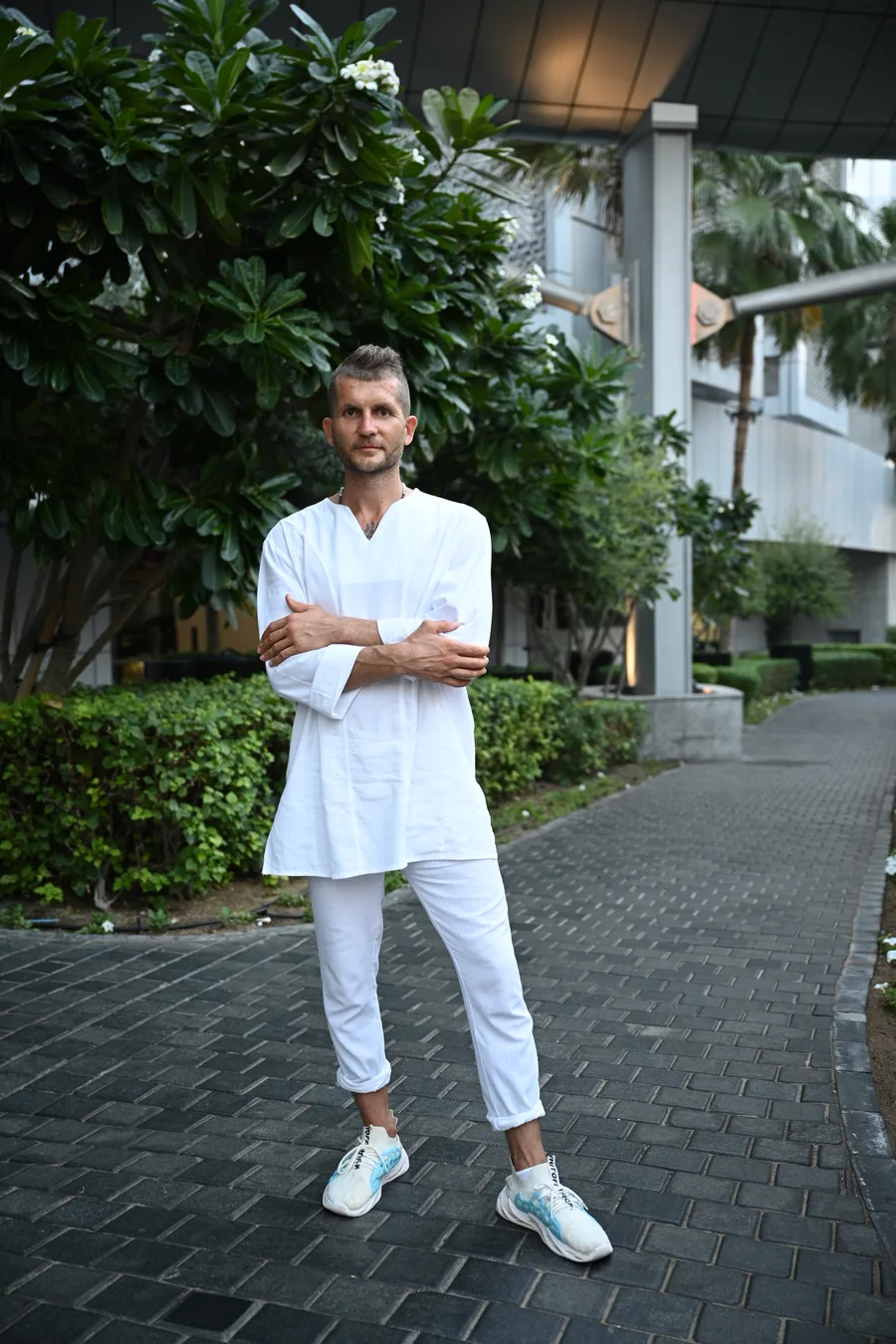
Vadim Kovalev in white on a stone path in a tropical garden
Two latitudes
The act “Two Hemispheres” — from the author’s autobiography

The method found in 2015 had to be practised somewhere. And the first thing he chose was not a hall but latitudes.

Thirteen years of his life passed in the tropics, and for many of them his home has been a mountain. There is no electricity: evening light comes from a kerosene lamp and candles. No running water: the water comes from a waterfall on his land. No connection: he goes online in a short evening window to pass the work on. Here conditions set the order of the day — light, water and silence — and the author lives inside the very subject he researches: he changes a condition and sees what changes in a living system.

How the method of two hemispheres works →collapse
“The system of practice was based on work in the northern and southern hemispheres of the earth, in different equatorial zones, on the islands of Koh Phangan and Bali, in alternation.”Vadim Kovalev · stage 2

This is not a poetic figure but a measurable framework. Koh Phangan lies at roughly the tenth parallel north of the equator, Bali at roughly the ninth south. Almost a mirror. The practice moved from one point to the other, like a pendulum across the equator. He still chooses the places where he lives by the nodes of the planet’s crystal lattice. In all, the tropics take up thirteen years of his biography; for many of them — a mountain without electricity, running water or connection, going online in a short evening window to pass the work on.

How the method itself works

In the language of the method — and the author specifically stipulates that he is speaking its language, not the language of physics — a group of participants builds multidimensional holographic structures that interact with a person’s field and their holographic matrix at all levels. The work is collective in essence, not for convenience: one person does not build such a structure. This is how the “Alchemy of Sacred Geometry” method from chapter 06 looks in practice — not the occupation of a loner but a construction held by several people at once.

What those who went through the practice say about it, the author gives in their words rather than his own:

“…in its intensity and effectiveness for the development of consciousness it is generations ahead of all known and available practices of this kind.”Participants of the practice · quoted by Vadim Kovalev

This is the experience of people who went through the practice — told in their own words. “Generations ahead” is how they themselves describe what they lived through. What exists is the method, the islands, the groups and years of work; each person draws their own conclusions once they have gone through it. Exactly the same principle as in the whole story above: experience becomes the source of the next question.


The author’s central principle

In the author’s picture of the world it is impossible to force a complex system to become more organised — but it is possible to create conditions in which the probability of its self-organisation increases.

One and the same question runs through the whole story — only the object changes: what creates the conditions under which a complex system moves to a higher level of organisation?

The principle in action · two panels, one set of elements
Why the left lattice falls apart and the right one stands →collapse

What is shown. Both panels start the same way — a set of elements in disarray. On the left, order is imposed from outside: while there is pressure, the lattice stands; once the pressure is gone, the lattice falls apart. On the right, nobody moves the elements: the environment changes, and order assembles itself, from a few points outwards, and after the hand is withdrawn, it remains.

That order in an open system is born and sustained through exchange with the environment, rather than through external control of each element, is established science of self-organisation. Transferring this same principle to the human being — and the conclusion that one should work with conditions rather than with the person themselves — is the position of DSOT. It rests on Hermann Haken’s synergetics: he showed that the order parameter of the whole system governs the behaviour of its many parts, and DSOT reads a person and their environment by the same measure. It was this position that led the author through all seven chapters above: the object changed, but the question remained the same.

One question — four objects: society, the human being, environment, structures →collapse
ch. 02 · Researching societysociety ch. 04 · A change in the object of researchthe human being ch. 05–07 · the inner laboratory, the turn, environmentenvironment ch. 06 · A dream that became a questionstructures

The first object of his research was society. Today the same question is gathered at a different scale — not by a crowd but by a structure of three: how the platform’s community is arranged →


The seventh day · a vision

The Game register · Lore

What follows is a different register. Above, the story is told in scientific language; here you will see what he himself saw — the source from which the question grew.

What was shown on the seventh day →collapse

The seventh day of the silent retreat on Samui — after three years of daily practice. Chapter 06 above calls it “a dream that became a question”; here is what this dream consisted of.

  • The images place a huge stone resembling a diamond in the area of the third eye.
  • A connection with pyramids radiating light — contact with “the primary source of all that exists”; and an underground pyramid from which powerful radiance comes.
  • Geometric forms are revealed as the basis of the creation of the Universe.
  • Former ideas about oneself are recognised as masks: automatisms and sub-personalities that prevented him from being himself.
  • The key image of the whole book is a stump and a spring beneath it. Word for word: “I saw myself as an old stump, but at the same time I felt that beneath this stump a clear, inexhaustible spring was welling up”; and the conclusion from the same place — “I thought that my nature was exhausted, but it turned out that I am part of the great, divine, infinite”.
  • Cosmic consciousness — “an incredible feeling of unity with the Universe, when reality was laid bare in its true form”.

An instrument of change

The most important thing seen that day was not an image and not a formula but a commission: through him an instrument would come to the Earth with which humanity and the planet would make the transition. Exactly how, he did not know at the time, and he says so directly; the knowledge of “how” came later, as separate work, and took years.

This moment in “The Story of Awakening” →collapse
“At the moment of my awakening I saw many revelations — the most important was that THROUGH ME, ON EARTH AND FOR HUMANITY, an instrument would be realised with which all of humanity and the planet would make a breakthrough. Then I did not know how, but later I was able to find a way for every person to experience the awakening that I experienced.”Vadim Kovalev · “The Story of Awakening”

The instrument was shown as connected with geometry, field, sound and frequency. This is the missing link between the biography and the substance: years of experiments with water, crystalline structures and environmental conditions began not with the idea of a product but with this very “then I did not know how”.

Coda · a gift to the world

I went through all the stages of the great alchemical path: taking apart, reassembly and rebirth. Kovalev Mineral is not just an artefact, it is a bridge between worlds, between the visible and the invisible, between what we know and what is yet to be discovered. Alchemy is real: it is not only in ancient books and legends — it is in each of us, if only we awaken it.Vadim Kovalev · “The Story of Awakening”

The three stages of this path — taking apart, reassembly, rebirth — are the framework of the quest above. This section is written in the genre of the Game: it is the language of images and of the inner path. Another register speaks about the substance itself — the DSOT scientific section, where the same questions are examined rigorously.


About me

Vadim Kovalev in white, temple-complex roofs behind him
About me
Long version, 01.08.2026

“I understand that each of us has a unique contribution to make to the world, and that our uniqueness makes the world better and more diverse. I am ready to share my knowledge and experience to help other people walk the same path that I walked.”

Continued →collapse

“My life is an example of how one can follow one’s heart and talent to find one’s place in the world and leave one’s mark on history. I believe that each of us can become an instrument of the Great Work and contribute to making the world better.”

The circle closes exactly where it opened. The question that the eighteen-year-old student asked himself in the university library — “how can I be useful to the world and to people? how can I become an instrument of the Great Work?” — returns at the end of the path no longer as a question but as work that can be handed on to someone else.


How this platform is different

Six differences you can see right now — before you have believed anyone →collapse

There is sense in only one thing: naming the differences that can be seen right now, before you have believed anyone. None of the six below needs to be taken on trust: each has a link to the page where you will see it openly.

  • 01 · The corpus The works are published in full, not as announcements The author’s works are available as text — with a reader, bookmarks and a return to the point where you stopped: you get the work in full and see your progress through each one. Next to them is a curated shelf: outside authors whom he names himself, with a note on how this is known. The corpus library →
  • 02 · The scientific circuit Every statement has its status named Every statement shows its status: 🟢 verifiable fact · 🟡 hypothesis in progress. The mark stands next to the statement itself, not in small print at the bottom of the page. The scientific circuit is set apart as a separate centre: acceptance of others’ works, internal peer review, the PAU Press publishing house. How we mark it →The DSOT book →
  • 03 · Research What does not exist yet is shown too The research page is called exactly that — “what is under protocol and what does not yet exist”: next to the observations stands an open list of missing measurements and a map of the sources of the scientific work. This is our wording on our own page; you can open it and compare. How the check works →
  • 04 · The University The teaching has a published standard Lex Academica — the code on which any programme is built: seven mandatory elements, five questions to ask of it, four levels of mastery and ten principles of quality, the same for any subject. It also says plainly: this is the standard of an independent international centre, not a state educational standard and not a licence. The University itself has twenty-two faculties (I–XXII) and seven fundamental sciences, the path Student → Professor. Lex Academica →University →
  • 05 · The lattice Part of the system happens off the screen The planetary lattice is not a picture but three layers of strict geometry: a skeleton of 62 nodes, a fractal field of 162 and 156 living points on the map. Leading to these points are offline routes — a road and a place, not a webinar. The author still chooses the places where he lives by the nodes of this lattice (the “Two latitudes” chapter above). The Earth’s geo-frame →Sacred journeys →
  • 06 · The author You can see where the document is and where the testimony is The story above comes with dates, a dossier and a clear boundary: the belt stands in the block of distinctions. Where the measured ends and hypothesis begins is stated on this same page, not in a footnote to another one. The author’s dossier →

The platform does not sell a result. There are no comparisons of the “we are better than someone” kind here: other platforms are neither named nor analysed. Scientific statements are marked with a traffic light on their own pages; here the talk is only about what this platform is made of.


How the mineral’s path to a person is arranged

three differences, and each has a link

The mineral comes directly from the workshop. There are three differences, and none of them needs to be taken on trust — each has a link to the page where it lies open. Other products and platforms are still not named here: the point is how this circuit is arranged.

  • 01 · Participation A purchase is an entry into research Here a person keeps an observation: they note their own state, and depersonalised observations go into a common dataset. You become a participant with the first questionnaire — even if you start nothing further: some people fill in the entry form and go no further, and this is the most valuable part of the dataset, the comparison group. Consent to the use of depersonalised answers is a separate tick box; it is withdrawn in one click and does not affect access. The circle of participants over the years numbers thousands of people; what they have left — texts, videos, correspondence — makes up the sample on which the quantitative and qualitative analysis works. Become a participant — a 2-minute entry →What happens to the data →
  • 02 · The circuit Closed circuit The mineral is not on marketplaces and does not go through resellers — it comes directly from the workshop, at one published price, the same for everyone. Eight levels from 233 to 6,765 €, logistics through a closed circuit. The terms are published before you enter and are the same for everyone: there are no private terms for “insiders” of any kind. The legal form of the circuit is being put together by lawyers: the mineral itself is an ordinary product, the university and the community are information products; we call a status a status and do not pass off work in progress as a finished document. What is included in a mineral order →Delivery →
  • 03 · Science Years of research, and you can see where the measured ends Behind the mineral stands the DSOT research programme and two separate works: empirical work on the water–mineral system, prepared in the genre of a 2026 PhD (format: physical chemistry · molecular liquids), and a work on technologies of directed self-organisation — the language in which DSOT describes the development of complex systems. The protocol is described, the thresholds are named before measurement; the measurement result is an open question, and the framing “exploratory study, with no conclusion about causality” is set by the author himself in the text of the work — it is kept here too. Next to it lies, openly, a list of what has not yet been measured. What you are invited to check is the method, not a story about it. How the check works →The DSOT book →

No other brand, platform or category of goods is named or analysed here. There are no promises of results or timeframes in days in this section — just as in the whole section above. Everything called a fact you can open via the link next to it.


Where the platform’s structure comes from

The author’s prototypes · 2024–2026

This platform was not invented from a blank sheet. Before it, the author assembled his vision himself — in four prototype pages and two living applications in Telegram, which have been working since the end of 2024. We did not inherit them silently: below it is named what grew out of what and where it now lies open.

  • 01 · Four prototypes The author’s four prototypes Four pages, each about its own side of the undertaking: Elite — the elite line, Harmony — the product line, Synergy — the ecosystem, Business — the business side. Each showed its own facet of the idea; what is in force is what is published here.
  • 02 · Two living applications The line of meditations worked before the platform Back at the end of 2024 the author published two of his mini-applications in Telegram: 18.11.2024 — with a series of meditations on the elements, 06.12.2024 — with the system of eight notes “Attunements of the Harmonics of Creation”. Both still open today. The meditations page grew out of this line: the recordings there are the author’s, the order of the notes is his, and both links are named right on it. The eight notes and both applications →
  • 03 · What grew out of what Each prototype reached its own page The elite line from Elite — these are the upper levels of the mineral and their composition. The product line Harmony — the mineral itself and the practice alongside it. Synergy and Business — the community and the personal account. None of these pages retells the prototype: what is inherited is the order of presentation, while the facts, prices and terms are our own, published and the same for everyone. Levels and composition →Kovalev Mineral →Personal account →
  • 04 · What the platform took The structure was taken, not the text What was taken from the prototypes is the structure and the order of presentation, not the text. Everything that concerns money, terms and composition the platform publishes in its own words and keeps in one place: one published price, the same for everyone. The terms in force are those published here. Terms of purchase →

The prototypes are named but not linked: the project’s public pages are here, and the terms on them are the same for everyone.


Work, land and new professions

Work, land and the city

The platform is needed for this too: for work, land and choosing the place where a person lives.

What follows from this — and where the boundary lies →collapse

How it works — without a list of trades and without the advice to “just leave”

  • There are skills that feed you where you stand, and skills that feed you anywhere. The difference is not in the worth of the profession but in whether it needs a particular employer in a particular city. Once you understand which of your skills is of which kind, the place you live will become a choice rather than a given.
  • The place where a person lives is most often chosen not by them but by circumstances — yet they live as though they had chosen it themselves and it cannot be reconsidered. This is the one condition of life that is almost never tested for strength.
  • The cost of living differs more than is usually thought: in some places your month costs as much as a week in others. We name neither sums nor countries — they go out of date faster than the page. You will find your own numbers by comparing two places you know.
  • There are usually more opportunities than can be seen from inside a familiar circle. This is an observation — test it on yourself: online work requires a connection, a language, a skill and clients, and some people do not have these conditions today — because of circumstances, not laziness.
  • Work is experienced according to whether it reaches someone’s hands. A person who gives cheese to a neighbour and a person who sends a report into a system spend the same time — and receive different things.

Where the boundary lies

Many have neither the freedom to leave nor the possibility of starting over: ill parents, children at school, obligations, work that cannot be moved. A currency collapse, an illness, a lost job — circumstances a person did not choose. Not every mistake is a fault, and what makes sense to examine is not “how you got here” but what of this can be changed in the coming year.

And about the city — also without labels

The point is not the city but the fact that in a city it is easier not to notice what you are working for: the result goes too far away and does not come back to anyone’s hands. The other half is just as honest: the city gives medicine, learning, meetings and the possibility of pursuing a rare occupation that in a village there is simply nobody to share with. And life on the land is not less work, but different work: there is weather, the season and months with no money at all. Nobody is judged here — neither those who left nor those who stayed.

This section is about one thing: how much effort goes on daily life in different places and what each of them gives a person.


The author’s manifesto

The alchemy of life: a path to God, to potential and to true joy

An alchemist is not simply a person who studies secret sciences. He is a guide who helps to remake life, turning darkness into light, suffering into love and limitations into boundless possibilities.

Where the alchemist’s path begins — and three conditions →collapse

The alchemist’s path begins with a realisation: to change your reality, you must first of all change yourself. He reveals the divine potential laid down in each of us — the ability to love, to rejoice and to create.

What is needed for this?

  1. Purity of intention. This is the first step to opening access to your inner source of strength.
  2. Faith in oneself and in higher powers. The alchemist knows that a human being is a microcosm connected with the infinite Universe.
  3. Practice and awareness. Through meditation, work with one’s state, alchemical transmutations and the unfolding of one’s inner potential, he reaches harmony and enlightenment.

The alchemist’s life is a choice to love, to create and to be in harmony with the world. Such an approach makes it possible to live each day as a unique gift, finding joy in the simplest things.

This path is open to everyone who is ready to awaken God within themselves, to attune to intuition and to realise their true nature.

The manifesto is Vadim Kovalev’s philosophical framework: his path, his picture of the world and his language. The strict scientific register of the same questions lives separately, in the DSOT section.


This is the path of Vadim Kovalev — from the question he asked himself in the library of Tomsk University to Kovalev Mineral. His sporting achievements can be seen in the block of distinctions. Observations on the influence of fields, crystalline structures and the mineral on a person’s state are material of the open DSOT research programme. In the publications of the author’s channel the name Hermes also appears — we keep it as a fact of the environment, not as a title.

What grew out of this

The decision is precisely dated: December 2011. From this point the object of research finally changed from society to the human being — and the subject of this work today stands on a separate page.

Kovalev Mineral — the subject of his work → · The technology itself →

The path that began with a question about oneself came together into a system of five steps.

  1. 1
  2. 2
  3. 3
  4. 4
  5. 5
  1. 1. recognition
  2. 2. self-awareness
  3. 3. coherence
  4. 4. the nature of consciousness
  5. 5. unity

The first step is yours: notice how your familiar image of yourself is assembled. Where this path leads next is in the author’s concept.

The author’s concept — what this path came together into →